
Professional reinforced concrete services play a vital role in modern construction, especially for residential and commercial buildings that demand strength, durability, and long-term safety. Reinforced concrete combines high-compressive-strength concrete with steel reinforcement, creating a structural system capable of handling heavy loads, environmental stress, and long service life.
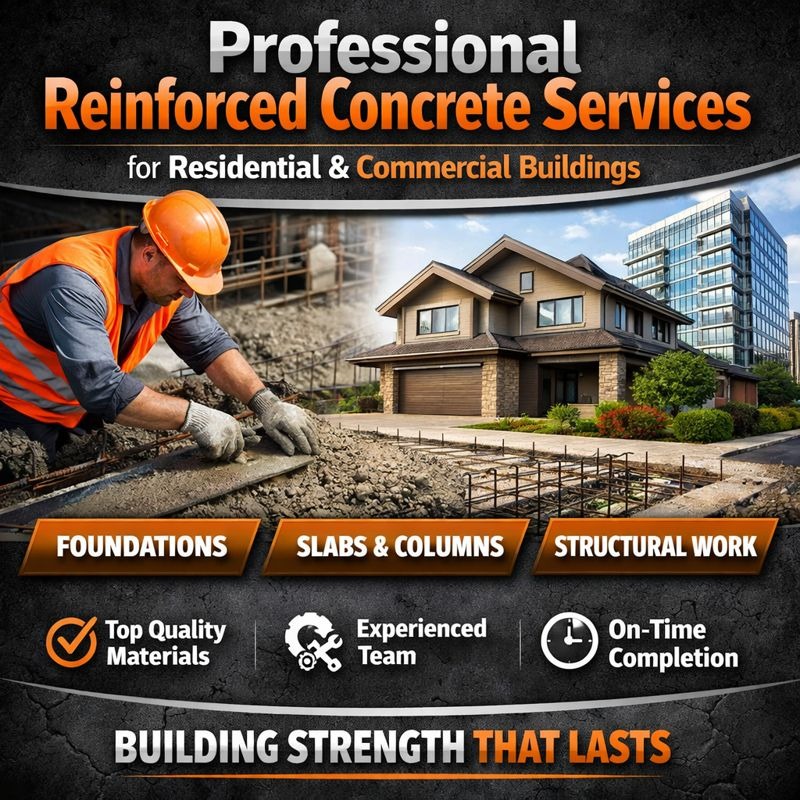
In this article, we provide a comprehensive overview of reinforced concrete services, including construction processes, applications, concrete quality standards, and why hiring professional contractors is essential for successful building projects.
What Are Reinforced Concrete Services?
Reinforced concrete services refer to professional construction works involving concrete combined with steel reinforcement bars (rebar). This method enhances structural performance by improving resistance to both compression and tension forces.
These services typically include concrete pouring, reinforcement installation, formwork preparation, and proper curing to ensure maximum structural integrity.
Why Reinforced Concrete Is Essential in Modern Construction
Reinforced concrete is widely used because it offers an excellent balance between strength, flexibility, and cost-efficiency. Concrete alone performs well under compression, while steel reinforcement absorbs tensile stresses, preventing cracks and structural failure.
This combination makes reinforced concrete ideal for buildings that require high load-bearing capacity and long-term reliability.
Scope of Professional Reinforced Concrete Services
Professional reinforced concrete contractors usually handle a wide range of structural works, including:
-
Foundation and footing construction
-
Reinforced concrete columns and beams
-
Floor slabs and suspended slabs
-
Concrete stairs and retaining walls
-
Structural frameworks for residential buildings
-
Reinforced concrete structures for commercial and industrial buildings
Each project is executed according to engineering drawings and safety standards.
Reinforced Concrete Services for Residential Buildings
In residential construction, reinforced concrete is used for foundations, tie beams, columns, floor slabs, and roof decks. Proper concrete pouring and reinforcement placement ensure that houses remain structurally sound, crack-resistant, and safe for long-term occupancy.
Hiring professional reinforced concrete services minimizes construction risks and ensures compliance with structural design requirements.
Reinforced Concrete Services for Commercial Buildings
Commercial buildings such as offices, warehouses, shopping centers, and mixed-use developments require higher structural performance. Reinforced concrete services for commercial projects involve precise planning, strict quality control, and professional execution.
Concrete pumping systems are often used to improve efficiency and ensure smooth pouring in hard-to-reach areas.
Reinforced Concrete Construction Process
1. Site Inspection and Planning
The process begins with site inspection to assess soil conditions, access points, and construction requirements. This stage determines the appropriate concrete delivery method and equipment.
2. Formwork Installation
Formwork is installed to shape the concrete structure. It must be strong, stable, and leak-proof to withstand fresh concrete pressure.
3. Steel Reinforcement Placement
Steel rebars are installed according to structural drawings. Proper spacing, anchorage, and connections are critical for ensuring structural strength.
4. Concrete Pouring
Concrete is poured evenly into the formwork. Ready mix concrete is highly recommended for consistent quality and controlled strength.
5. Concrete Curing
Curing maintains moisture levels in concrete to support proper hydration. This step significantly improves concrete strength and durability.
Concrete Quality Standards and Strength Grades
Selecting the correct concrete strength is crucial for reinforced concrete structures. Common strength grades range from medium to high strength, depending on building function and load requirements.
Professional contractors ensure that the concrete mix meets structural specifications and industry standards.
Advantages of Hiring Professional Reinforced Concrete Contractors
Working with experienced reinforced concrete contractors provides several benefits:
-
Structural accuracy and compliance with engineering standards
-
High-quality concrete materials
-
Skilled labor and professional supervision
-
Faster construction timelines
-
Reduced risk of structural defects
-
Long-lasting and durable building performance
These advantages make professional services a smart investment for both residential and commercial projects.
Factors Affecting Reinforced Concrete Service Costs
Several factors influence the overall cost of reinforced concrete services, including:
-
Project size and concrete volume
-
Selected concrete strength grade
-
Structural complexity
-
Site accessibility
-
Equipment usage (concrete pumps, mixers)
-
Labor requirements
Proper planning and transparent cost estimation help control construction budgets without sacrificing quality.
Common Mistakes in Reinforced Concrete Construction
Some common issues in reinforced concrete work include improper reinforcement placement, incorrect concrete mix selection, poor formwork installation, and inadequate curing. These mistakes can lead to cracks, reduced strength, and long-term structural problems.
Professional reinforced concrete services help prevent these risks through proper supervision and quality control.
Conclusion
Professional reinforced concrete services for residential and commercial buildings are essential for creating strong, safe, and durable structures. From proper planning and reinforcement installation to concrete pouring and curing, every stage plays a critical role in structural performance.
By choosing experienced contractors and using high-quality ready mix concrete, building owners can ensure long-term reliability and safety for their construction projects.